Thunder Report | Analysis
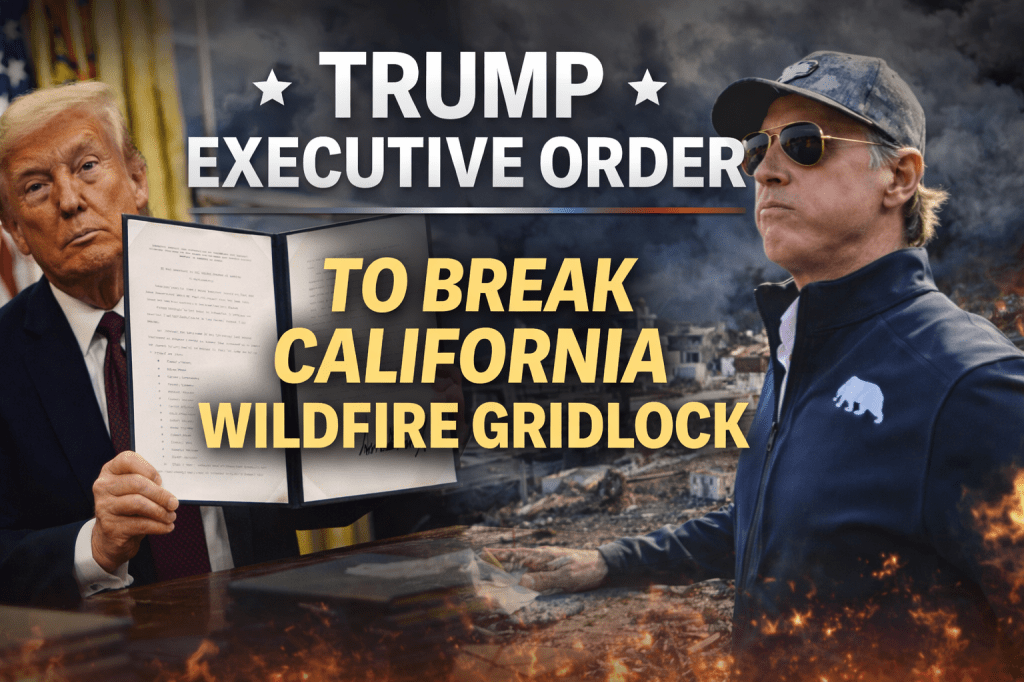
When Donald Trump signed an executive order aimed at accelerating federal control and coordination over the Los Angeles wildfire rebuilding and permitting process, it wasn’t just a policy move—it was a direct challenge to California’s governing model.
The order targets what many residents have experienced firsthand: a maze of state and local regulations that slow emergency recovery to a crawl. By asserting stronger federal authority over permitting timelines, interagency coordination, and emergency waivers, the administration signaled that speed and execution now outweigh procedural perfection.
What the Executive Order Does
At its core, the order is about time—time families don’t have, businesses can’t afford, and communities can’t recover without. Key elements include:
- Federal lead coordination to prevent duplicative reviews across agencies
- Expedited permitting for rebuilding primary residences and critical infrastructure
- Temporary suspension or narrowing of overlapping reviews that delay reconstruction without improving safety
- Clear deadlines for agency responses, replacing open-ended processes
The practical effect: rebuilding moves on a crisis timeline, not a regulatory one.
Why Federal Takeover Became Necessary
This intervention didn’t appear out of nowhere. For years, California officials—under Gavin Newsom—have promised to “streamline” wildfire recovery. Yet survivors continue to report months-long waits just to break ground, with approvals bouncing between state environmental agencies, county offices, and local boards.
The executive order functions as an implicit indictment: if the state had delivered on its promises, federal takeover wouldn’t be needed.
A Different Governing Philosophy
Trump’s approach reflects a familiar governing principle—in emergencies, government exists to act, not arbitrate. The order prioritizes outcomes over optics, and results over rhetoric. It treats wildfire recovery like a national emergency, not a policy seminar.
Critics argue this risks sidelining environmental safeguards. Supporters counter that families living in trailers and small businesses closed for years are themselves an environmental and human crisis.
Political Implications Beyond California
The move also has national reverberations. As Newsom’s name circulates in future presidential conversations, the wildfire rebuild becomes more than a state issue—it becomes a case study in executive competence.
By stepping in decisively, Trump reframed the debate: Who actually gets things done when systems fail? That contrast is likely to echo well beyond Los Angeles.
The Bottom Line
Trump’s executive order didn’t just speed up rebuilding—it exposed a fault line in modern governance. When layers of bureaucracy paralyze recovery, leadership means cutting through them.
For Californians still waiting to come home, the message is simple: relief delayed is relief denied. And in this moment, the federal government chose action over excuses.
Support Independent Journalism
California Bay News is part of the Bay News Media Network — a growing group of independent, reader-supported newsrooms covering government accountability, courts, public safety, and institutional failures across the country.
Support independent journalism that isn’t funded by political parties, corporations, or government agencies
Submit tips or documents securely — if you see something wrong, we want to know
Independent reporting only works when readers stay engaged. Your attention, tips, and support help keep these stories alive.
 California Bay News
Leave a comment