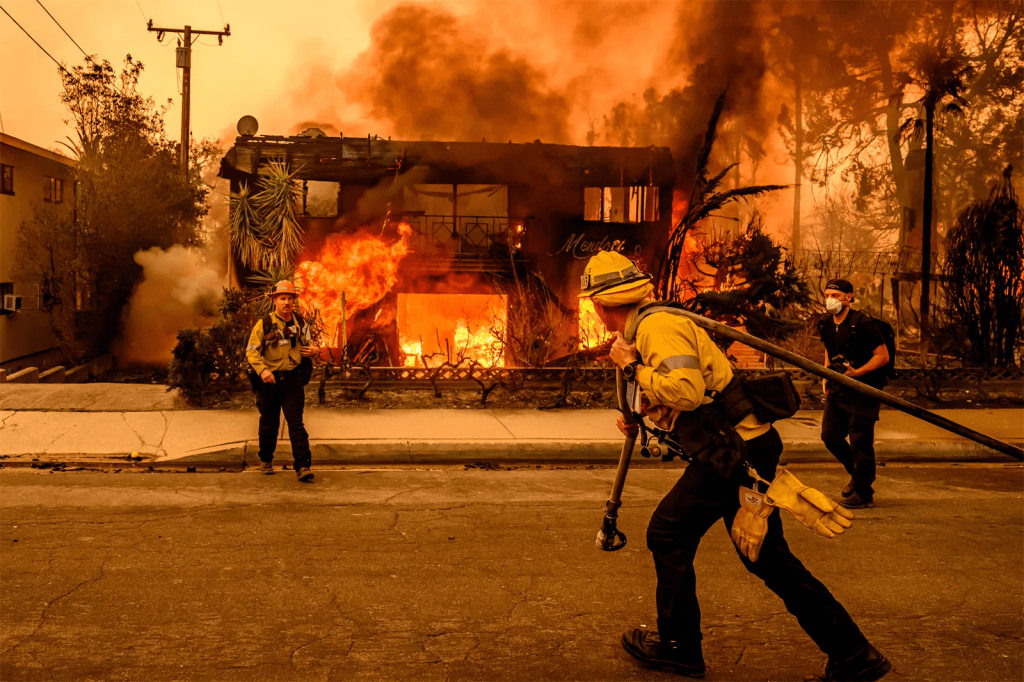
By Michael Phillips | CABayNews
The January 2025 wildfire disaster in Southern California was not merely another tragic chapter in the state’s long struggle with fire. It was a systemic failure—of preparedness, response, and recovery—laid bare for millions of Californians who watched entire communities burn while government institutions lagged behind.
Major blazes including the Eaton Fire in Altadena and the Pacific Palisades fire erupted during extreme Santa Ana wind conditions, scorching more than 37,000 acres across Los Angeles County. More than 30 people lost their lives. Over 16,000 homes, businesses, and structures were destroyed in Altadena, Pacific Palisades, Malibu, and surrounding communities. One year later, the human toll remains staggering.
Delayed Response and Preventable Damage
Residents in affected areas recount evacuation orders that came late—or not at all. Emergency resources were stretched thin, and initial suppression efforts faltered as fires spread rapidly through dense, overgrown vegetation and aging infrastructure.
Utility equipment failures, including lines linked to Southern California Edison, are the subject of ongoing lawsuits. But settlements have moved slowly, with the state’s strained insurance system and public funds increasingly absorbing costs that private insurers once covered.
Critics argue these failures were years in the making. California’s approach to forest and brush management—shaped by environmental litigation, regulatory layering, and high labor costs—left vast fuel loads untouched. When conditions turned volatile, the outcome was catastrophic.
A Year Later: Recovery Still Stalled
As of early 2026, recovery remains painfully slow. While nearly 12,000 lots have been cleared of debris, rebuilding tells a different story. Out of thousands of destroyed properties, only a handful of homes in the Eaton and Palisades burn zones have been rebuilt. Countywide, roughly 1,100 rebuilding permits have been approved—far below what would be expected after a disaster of this magnitude.
Approximately 75 percent of survivors remain displaced, many paying mortgages on homes that no longer exist while temporary housing arrangements grow increasingly unstable. Mortgage forbearance programs are expiring, insurance payouts often fall short, and construction costs continue to climb.
Governor Gavin Newsom has issued multiple executive orders suspending certain permitting and environmental review requirements, extending price-gouging protections, and allowing temporary flexibility for businesses and leases in areas like Topanga State Park. These moves acknowledge the problem—but for many families, they arrived far too late.
Bureaucracy, NIMBYism, and Inequality
Rebuilding in California is notoriously difficult even in normal times. After the 2025 fires, strict building codes, environmental reviews, and local opposition have made reconstruction nearly impossible for middle- and working-class families. Only about 15 percent of destroyed structures have received permits.
Wealthier neighborhoods are rebounding faster, often with luxury rebuilds funded by private remediation and legal teams. In contrast, communities like Altadena—home to many Black and middle-class families with generational ties—are seeing residents forced to sell burned lots at a loss, raising fears of displacement and opportunistic land consolidation.
Some Altadena residents are now pursuing incorporation, arguing that greater local control could prevent future mismanagement and speed recovery.
A Quiet Health Crisis in the Ash
Less visible, but deeply concerning, are the lingering health and environmental risks. Unlike prior wildfire recoveries, federal agencies did not conduct comprehensive post-cleanup soil testing. Independent investigations by journalists, universities, and county health officials found elevated lead levels in 30 to 80 percent of tested samples in the Eaton burn area—often on lots already declared “cleared.”
Lead, arsenic, mercury, and other toxins released from burned structures pose serious long-term risks, particularly for children. Many families have paid thousands of dollars out of pocket for private testing and remediation, costs that wealthier homeowners can absorb and others cannot.
Insurance on the Brink
The fires have further destabilized California’s insurance market. Underinsurance was widespread, and the state’s FAIR Plan—designed as a last resort—has struggled to keep pace. Analysts warn of potential “catastrophic failure” if reforms are not enacted, with insurers retreating from high-risk zones and premiums soaring for those who remain.
Lost home values alone are estimated at $8.3 billion. For many families, rebuilding simply does not pencil out.
Leadership Under Scrutiny
The wildfire crisis has intensified broader criticisms of Governor Newsom’s leadership, particularly regarding prevention and fiscal priorities. Budget cuts to wildfire resilience programs in recent years, vetoed firefighter pay legislation, and stalled infrastructure projects have become focal points for critics who argue that California governs reactively rather than proactively.
Supporters point to billions spent on CAL FIRE staffing, climate resilience, and emergency aid, and acknowledge that extreme weather played a major role. But for survivors still living in limbo, those explanations ring hollow.
The Lesson Californians Can’t Ignore
The 2025 wildfires were not just a natural disaster. They were a stress test of California’s governance—and the system failed.
Without serious reforms to land management, utility accountability, insurance regulation, and rebuilding bureaucracy, the state risks repeating this cycle again and again. Climate conditions may be unavoidable, but policy paralysis is not.
Full recovery will take years. The question now is whether California’s leaders are willing to confront the structural failures exposed by the fires—or whether the next disaster will once again find the state unprepared, and its residents paying the price.
Support Independent Journalism
California Bay News is part of the Bay News Media Network — a growing group of independent, reader-supported newsrooms covering government accountability, courts, public safety, and institutional failures across the country.
Support independent journalism that isn’t funded by political parties, corporations, or government agencies
Submit tips or documents securely — if you see something wrong, we want to know
Independent reporting only works when readers stay engaged. Your attention, tips, and support help keep these stories alive.
 California Bay News
Leave a comment