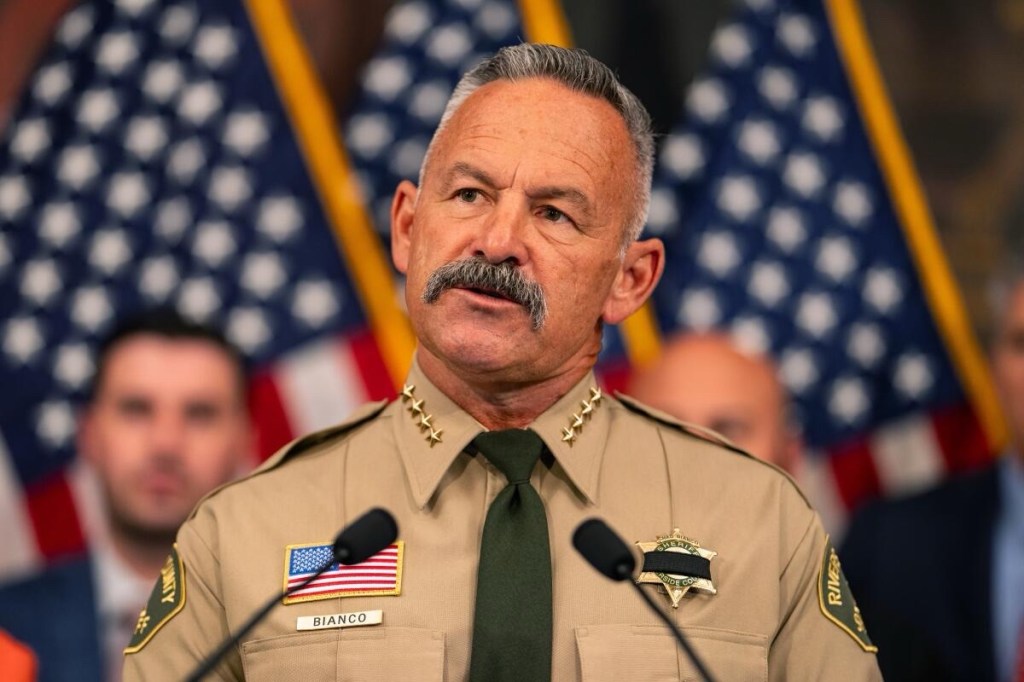
By Michael Phillips | CABayNews
As California’s 2026 gubernatorial race begins to take shape, one Republican candidate is building his campaign around a blunt and unmistakable message: public safety first. Chad Bianco, the longtime Riverside County sheriff, is running for governor on a law-and-order conservative platform that casts the election as a referendum on Democratic control in Sacramento and the policies championed by Gavin Newsom.
Bianco’s pitch is not subtle. He argues that California’s crises—crime, homelessness, affordability, and public distrust—are the predictable result of progressive governance that prioritizes ideology over competence. His campaign frames itself as what he calls a “revolution of competence,” aimed at restoring safety, accountability, and fiscal restraint.
Public Safety at the Center
Public safety is the core of Bianco’s campaign identity. As sheriff, he has been one of the state’s most vocal critics of “soft-on-crime” reforms, early prisoner releases, and what he describes as policies that embolden criminals while punishing law-abiding citizens.
Bianco has pledged to reverse those trends if elected governor. He supports tougher sentencing, backed Proposition 36 to restore felony charges for certain theft and drug crimes, and has vowed to reopen closed prisons to ensure violent offenders are kept off the streets. He also promises to reinvest in law enforcement staffing, recruitment, and retention, directly pushing back against years of “defund the police” rhetoric.
In contrast to Sacramento’s reform-heavy approach, Bianco argues that criminal justice reform should begin with victims, not offenders—a message that resonates strongly with conservative voters frustrated by rising crime and declining clearance rates.
Government Waste, Fraud, and the “Homeless Industrial Complex”
Bianco’s critique of California government extends well beyond crime. He frequently targets what he calls systemic waste, corruption, and fraud—particularly in homelessness spending. California has spent more than $24 billion on homelessness programs since 2019, yet visible encampments and unsheltered populations continue to grow.
Bianco labels this system a “homeless industrial complex,” accusing politically connected nonprofits and NGOs of enriching themselves while delivering little measurable progress. He has pledged to create a dedicated investigative team with broad authority to audit state spending, expose corruption, and prosecute offenders. His rhetoric is intentionally stark: “no stone left unturned” and, when warranted, “handcuffs.”
Taxes, Affordability, and Regulation
On economic issues, Bianco stakes out one of the most aggressive positions in the race: eliminating California’s state income tax entirely. He argues the state does not suffer from a revenue problem, but from unchecked spending and overregulation that drive up costs for working families.
Gas prices, housing affordability, electricity costs, and food prices all feature prominently in his speeches. Bianco blames these pressures on Democratic regulatory policies and promises to shrink government, cut waste, and ease regulatory burdens on businesses, farmers, and ranchers.
Second Amendment and Mandate Opposition
Bianco has also leaned heavily into cultural and constitutional issues. He has vowed to be the most pro–Second Amendment governor in California history and has openly criticized the state’s restrictive gun laws. During the COVID era, he opposed vaccine mandates and lockdown policies, reinforcing his broader anti-mandate stance that appeals to voters distrustful of government overreach.
A Polarizing Record Under Scrutiny
Bianco’s campaign is not without controversy. He remains a polarizing figure statewide, admired by conservatives and law enforcement supporters but sharply criticized by Democrats and civil rights groups.
The California Department of Justice, under Attorney General Rob Bonta, launched a civil rights “pattern or practice” investigation into the Riverside County Sheriff’s Department in 2023. The probe focuses on jail deaths, conditions of confinement, and allegations of unconstitutional policing. As of January 2026, the investigation remains ongoing, with no final findings released.
Bianco has dismissed the probe as politically motivated and insists his department has nothing to hide. Supporters view the investigation as partisan interference; critics see it as evidence of leadership failures. Either way, it has become a central line of attack for his opponents.
Electoral Reality Check
Politically, Bianco’s path to the governorship is steep. California remains a deep-blue state, and no Republican has won statewide office since 2006. However, the state’s top-two primary system creates an opening: a crowded Democratic field could split the vote, allowing two Republicans to advance to the general election.
Early polling shows Bianco competitive among Republicans and occasionally leading fragmented primary fields, though his support among Democrats is minimal. Analysts widely regard a Republican victory as a longshot, but Bianco’s candidacy underscores the depth of conservative frustration with California’s direction.
The Outsider’s Bet
Ultimately, Chad Bianco is running as an outsider sheriff challenging one-party rule with a message built on enforcement, fiscal discipline, and cultural pushback against progressive governance. Whether that message can break through California’s entrenched political realities remains doubtful—but in a volatile race with high voter dissatisfaction, his campaign ensures that law-and-order conservatism will have a loud voice in the 2026 debate.
For now, Bianco is betting that frustration with crime, costs, and Sacramento insiders outweighs party registration numbers—and that California voters are ready, at least to listen, to “try something different.”
 California Bay News
Leave a comment