By Michael Phillips | CABayNews
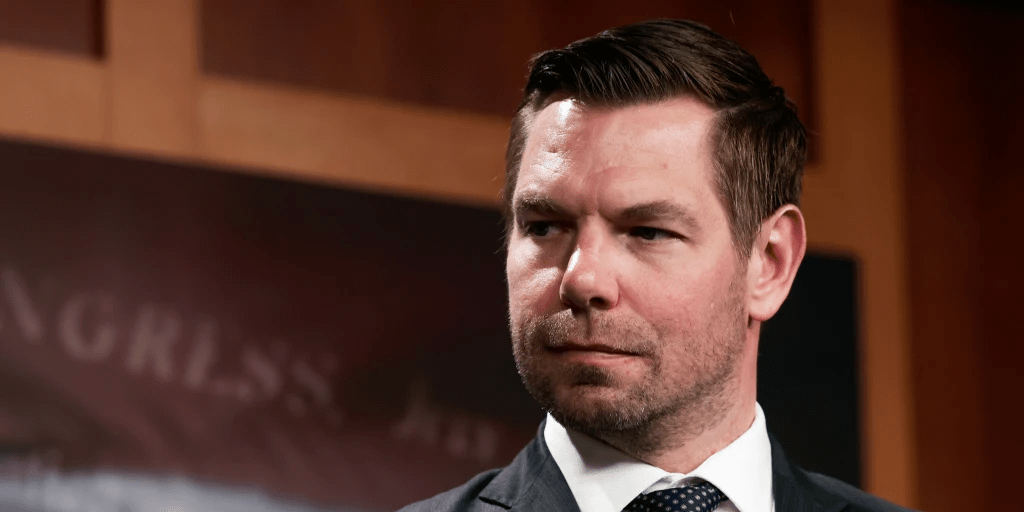
As California’s 2026 gubernatorial race takes shape, Eric Swalwell is staking out a familiar position: aggressive opposition to federal immigration enforcement. But his recent comments targeting U.S. Immigration and Customs Enforcement (ICE) agents raise serious questions about whether oversight has given way to political grandstanding—and whether California voters are being asked to accept a dangerous precedent.
“Unmasking” Federal Agents
In a widely circulated video clip from a NewsNation interview, Swalwell argued that ICE agents should be required to “take off their masks and show their faces” during enforcement actions. He framed the proposal as a transparency and accountability measure, warning that masked agents who fail to identify themselves should face legal consequences—including potential criminal charges if laws are violated.
Swalwell went further, suggesting that agents who refuse to unmask or properly identify themselves should not be eligible for California driver’s licenses. The rhetoric was explicit: California, under his leadership, would “go on offense” against federal agents he believes are acting unlawfully.
Conservative commentator Benny Johnson amplified the clip on X, portraying Swalwell’s remarks as a vow to expose and arrest ICE agents while California continues issuing driver’s licenses to undocumented immigrants under existing state law. That framing—whether fully accurate or not—captured why the comments exploded beyond a routine policy debate.
Accountability or Intimidation?
To be clear, Swalwell has not explicitly called for blanket arrests of ICE officers. His defenders argue that he is talking about accountability for specific criminal acts, not indiscriminate punishment. But politics is not a courtroom transcript, and his language matters—especially when it targets line-level federal officers.
During a July 2025 House Homeland Security Committee hearing, Swalwell compared masked ICE agents to “bank robbers terrorizing women,” a provocative analogy that inflamed critics. In other interviews, he claimed, “Real cops don’t wear masks,” dismissing long-standing law-enforcement practices designed to protect officers from retaliation by gangs, cartels, or extremist groups.
This is not occurring in a vacuum. ICE agents operate against transnational criminal organizations that have demonstrated a willingness to target law enforcement families. Masking, while controversial, is often justified as a basic safety measure—not a symbol of secrecy for secrecy’s sake.
The Federal-State Collision Course
Swalwell also supported H.R. 4004 in June 2025, legislation that would require ICE agents to clearly identify themselves and restrict facial coverings, with limited safety exceptions. That bill reflects a broader Democratic strategy: using legislation and budget pressure to constrain federal immigration enforcement.
California Governor Gavin Newsom has echoed similar concerns about impersonation and community trust. But critics argue that the cumulative effect of this rhetoric is to delegitimize federal authority entirely—turning immigration enforcement into a partisan culture-war battlefield rather than a serious governance issue.
Republicans and ICE supporters see Swalwell’s posture as reckless. In September 2025, the White House even cited him among officials accused of rhetoric that could incite violence against ICE by making agents “no longer faceless.” Whether one accepts that claim or not, it underscores how heated—and consequential—this debate has become.
A Gubernatorial Preview Californians Should Take Seriously
California already allows undocumented immigrants to obtain driver’s licenses under AB 60, a policy in place since 2015. Critics note the contradiction: a state willing to license undocumented residents while threatening to deny licenses to federal agents for following agency safety protocols.
For a gubernatorial candidate, this is not symbolic talk. Governors command the state’s law-enforcement posture, control cooperation with federal agencies, and shape the tone of civil order. Swalwell’s comments suggest a governorship defined less by pragmatic management and more by ideological confrontation with Washington.
Oversight of law enforcement is legitimate. Demonizing officers for political gain is not. As Californians evaluate Swalwell’s bid for governor, they should ask a simple question: does this approach make the state safer, or does it score points by escalating conflict with the very institutions tasked with enforcing the law?
In a state facing homelessness, crime, infrastructure decay, and a fragile budget outlook, voters may decide that unmasking ICE agents is less a solution—and more a distraction.
Support Independent Journalism
California Bay News is part of the Bay News Media Network — a growing group of independent, reader-supported newsrooms covering government accountability, courts, public safety, and institutional failures across the country.
Support independent journalism that isn’t funded by political parties, corporations, or government agencies
Submit tips or documents securely — if you see something wrong, we want to know
Independent reporting only works when readers stay engaged. Your attention, tips, and support help keep these stories alive.
 California Bay News
Leave a comment