By Michael Phillips | CABayNews
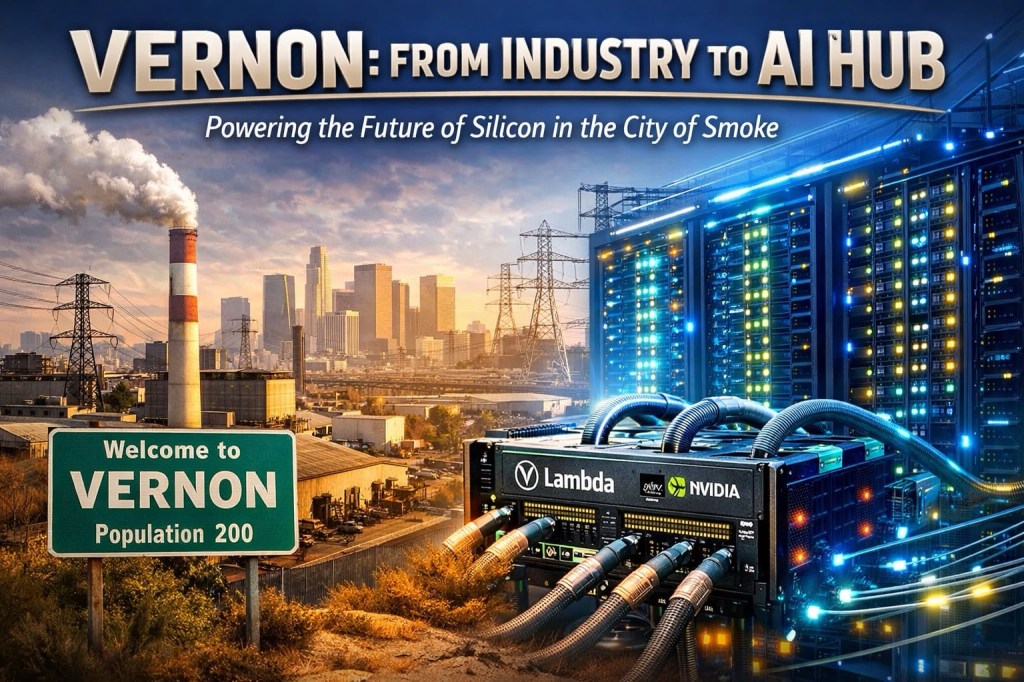
In a state better known for regulatory gridlock than industrial agility, the unlikeliest success story of California’s AI boom is unfolding in Vernon—a tiny, heavily industrial city with barely 200 residents and a reputation forged more in smokestacks than silicon chips.
According to a recent Los Angeles Times report, Vernon has quietly become Southern California’s most attractive destination for AI-driven data centers, drawing billions in private investment from companies racing to power the next generation of artificial intelligence.
The reason isn’t luck. It’s fundamentals.
Cheap Power, Fewer Politics, Faster Results
While much of California struggles to attract energy-intensive infrastructure, Vernon offers something increasingly rare: abundant electricity at competitive prices.
The city operates its own municipal utility, Vernon Public Utilities (VPU), selling power at rates often half those of LADWP or Southern California Edison, with excess capacity already in place. No multi-year environmental reviews just to buy more electrons. No ratepayer revolts. No ballot initiatives.
Just power—available when industry needs it.
Equally important: Vernon has almost no residential opposition. With virtually no neighborhoods to organize against noise, water use, or transmission upgrades, the city sidesteps the NIMBY paralysis that has stalled similar projects elsewhere in Los Angeles County.
For developers facing exploding demand from AI firms, that certainty is priceless.
From Slaughterhouses to Supercomputers
Developers including Prime Data Centers, Goodman Group, Digital Realty, and CoreSite are repurposing Vernon’s industrial real estate—former warehouses, office buildings, even a shuttered slaughterhouse—into high-density data campuses.
Prime’s flagship LAX01 campus alone spans more than 240,000 square feet and consumes enough electricity to power over 26,000 homes annually. Its tenants include Lambda, an AI cloud provider deploying NVIDIA’s latest Blackwell GPUs—hardware at the center of the global AI arms race.
This isn’t speculative development. Facilities are being fully pre-leased before construction is finished, a sign of just how desperate AI companies are for reliable power near Los Angeles’ digital backbone.
Escaping One Wilshire’s Bottleneck
For decades, downtown Los Angeles’ One Wilshire building served as the West Coast’s primary telecom hub, linking undersea cables from Asia to U.S. networks. Today, it’s overcrowded, expensive, and constrained.
Vernon—just five miles away—offers proximity without the premium.
As AI workloads shift from kilowatts to megawatts, proximity to fiber alone is no longer enough. Power availability now dictates geography—and Vernon wins that equation, for now.
The California Paradox
Statewide, California officials continue to talk up green innovation while simultaneously blocking the infrastructure needed to support it. Data center electricity and water usage has nearly doubled since 2019, and utilities are planning tens of billions in grid upgrades.
Yet Sacramento has resisted transparency requirements and meaningful permitting reform. Governor Gavin Newsom vetoed bills that would have required detailed reporting on data center energy and water use, delaying real oversight until at least 2027.
Vernon’s success exposes the paradox: California can still compete when local governments prioritize infrastructure over ideology.
A Model—or a Warning?
Vernon’s leaders insist their utility surplus can support growth without raising rates or straining resources, and so far, there’s little evidence to the contrary. Data centers bring stable revenue, predictable demand, and high-value industrial reuse—without displacing residents.
But analysts warn the advantage may not last forever. AI demand is accelerating faster than planners anticipated, and even Vernon’s surplus has limits.
Still, for now, this tiny industrial city stands as a reminder of what happens when government focuses on capacity, reliability, and speed instead of endless process.
In a state searching for its economic future, Vernon didn’t wait for permission. It built the foundation—and the AI industry followed.
 California Bay News
Leave a comment