By Michael Phillips | CABayNews & Father & Co.
A new decision from the Colorado Court of Appeals quietly but significantly reshapes how child-custody violations can be prosecuted in Colorado—and it carries major implications for parents caught in high-stakes child welfare cases.
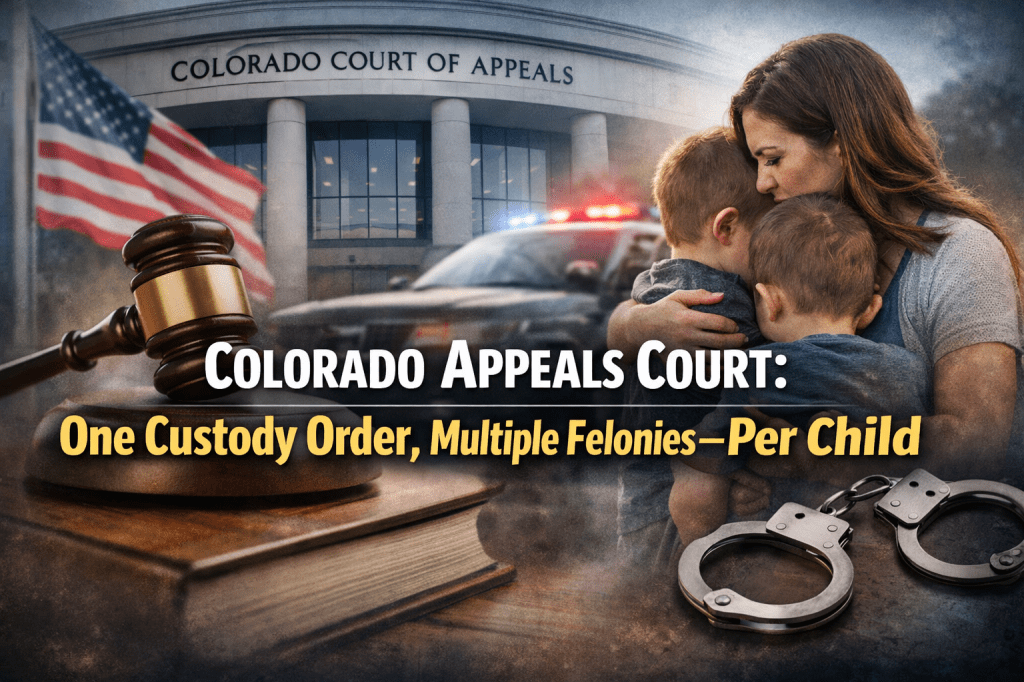
In People v. Wilson, decided December 24, 2025, a unanimous three-judge panel held that prosecutors may charge a separate felony count for each child affected by a violation of a custody order—even when there is only one court order involved.
What Happened
The case arose in Mesa County, where Tiffany Jean Wilson was confronted by a county caseworker presenting a single temporary order transferring custody of her four children to the county. Wilson then drove away with the children. A jury later convicted her of four separate counts of violating a custody order—one per child—each a class 5 felony, along with other charges.
On appeal, Wilson argued that the four convictions were “multiplicitous,” violating double-jeopardy protections because there was only one order to disobey. The court rejected that argument.
The Court’s Reasoning
Writing for the panel, Judge Rebecca R. Freyre focused on the language of Colorado Revised Statutes § 18-3-304. The statute criminalizes depriving a lawful custodian of “the custody or care of a child.” That repeated use of the singular, the court said, makes legislative intent clear: the unit of prosecution is each child, not each order.
In other words, if a single act deprives custody of multiple children, the law permits multiple felony counts—just as Colorado allows separate charges when a single criminal act harms multiple victims.
Why This Matters
This is the first time Colorado appellate courts have squarely addressed how § 18-3-304 should be charged in multi-child cases. The ruling gives district attorneys new leverage:
- Charge stacking: One decision during a custody confrontation can now trigger multiple felony counts.
- Higher exposure: Each class 5 felony carries potential prison time and significant fines.
- Greater bargaining power: Prosecutors gain added pressure in plea negotiations.
Supporters of the ruling argue it properly centers the welfare of each child, treating them as individual victims rather than collateral to a procedural violation.
A Center-Right Concern: Power Without Guardrails
For many parental-rights advocates, however, the decision raises red flags.
Colorado’s dependency and neglect system already operates under low initial evidentiary thresholds, with sealed proceedings that limit public scrutiny. Parents often face emergency removals first and must fight to regain custody later. Allowing per-child felony stacking—even when no violence is alleged—risks escalating family crises into life-altering criminal cases.
From a center-right perspective, this is the familiar tension between protecting children and restraining government power:
- Protect children from real harm? Absolutely.
- Turn moments of parental panic into stacked felonies? That deserves scrutiny.
The ruling may deter parents from resisting removals they believe are mistaken or unjust—while simultaneously increasing the state’s coercive power in already fraught situations.
What Comes Next
The decision is brand new. Wilson could still seek review from the Colorado Supreme Court, and lawmakers could respond by clarifying the statute’s scope. For now, the precedent stands.
Parents navigating Colorado’s custody or child welfare system should understand this clearly: one confrontation, multiple children, multiple felonies. The stakes just got higher.
 California Bay News
Leave a comment