By Michael Phillips | CABayNews and Father & Co.
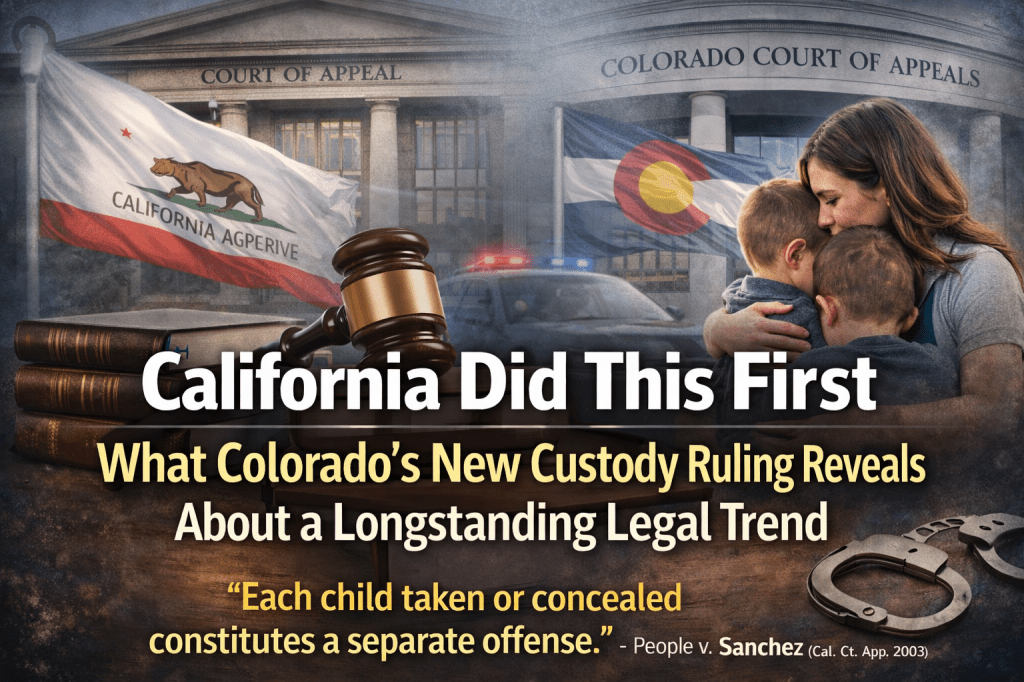
When the Colorado Court of Appeals ruled last week that prosecutors may charge one felony per child for violating a single custody order, the decision was widely described as groundbreaking.
In California, it wouldn’t have been.
For decades, California appellate courts have treated child custody and abduction crimes as per-child offenses, even when a parent’s conduct arises from a single act or a single court order. Colorado’s People v. Wilson ruling doesn’t create a new doctrine—it aligns Colorado with a framework California quietly normalized long ago.
California’s Legal Logic: Each Child Is a Separate Victim
California’s child abduction statutes—Penal Code §§ 278 and 278.5—criminalize the taking, concealment, or retention of a child from a lawful custodian. Courts have repeatedly emphasized that this language reflects legislative intent to protect individual children, not merely enforce court authority or vindicate parental rights.
As one appellate court explained, “each child taken or concealed constitutes a separate offense.” The harm, courts reason, is not abstract—it is personal to each child deprived of lawful custody.
This reasoning mirrors Colorado’s conclusion almost word for word.
One Order, Multiple Felonies—Already Normal in California
California courts have long rejected the argument that a single custody order limits prosecutors to a single charge. When multiple children are affected, courts permit multiple counts—even if the conduct is simultaneous.
The California Supreme Court’s unit-of-prosecution framework is blunt: when a statute is victim-centered, multiple convictions are constitutional. That principle applies across criminal law—and custody-related offenses are no exception.
In practice, this means a parent who interferes with a CPS removal or custody transfer involving three children may face three separate felony counts, even if the order itself is singular.
What Colorado Is Catching Up To
Colorado’s ruling formalizes what California has treated as settled law:
- Children are distinct legal victims
- Courts measure harm per child
- Prosecutors may stack charges accordingly
The difference is visibility. California’s approach developed incrementally, with little public debate. Colorado’s ruling arrived in a moment of heightened national scrutiny over CPS authority, parental rights, and family court power.
A Center-Right Warning From the California Experience
California’s experience also offers a cautionary tale.
Per-child charge stacking dramatically increases prosecutorial leverage in family crises—often at moments when parents are panicked, unrepresented, or facing emergency removals based on minimal evidence. What begins as a custody dispute can quickly become a multi-felony criminal case.
Supporters frame this as child protection. Critics see something else:
criminal law quietly expanding into family court, with few procedural guardrails.
Colorado may now be entering the same territory California charted years ago—where resisting a single custody order can carry life-altering criminal consequences multiplied by the number of children involved.
The Question Lawmakers Haven’t Answered
California courts answered the legal question long ago. Colorado has now done the same.
What neither state has seriously confronted is the policy question that follows:
How much criminal power should the state wield over families at their most vulnerable moments—and who is watching the watchers?
 California Bay News
Leave a comment