By Michael Phillips | CABayNews
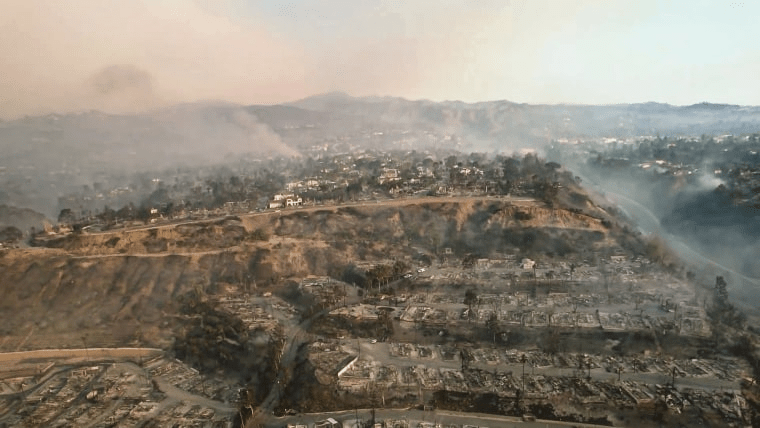
Nearly a year after the catastrophic Palisades and Eaton wildfires tore through Southern California—burning more than 37,000 acres, destroying over 16,000 structures, and displacing tens of thousands—California’s recovery remains painfully stalled. Now Governor Gavin Newsom is making his most aggressive move yet: a request to Washington for $33.9 billion in federal aid.
But as the governor tours Capitol Hill to plead for relief, a growing number of Californians are asking a different question:
Is this delay really Washington’s fault—
or the inevitable result of years of Sacramento’s mismanagement?
A Disaster Years in the Making
The January 2025 wildfires were driven by drought and Santa Ana winds topping 70 mph. But they were also magnified by factors completely within state control:
• Failed water infrastructure
Firefighters reported hydrants running dry across Pacific Palisades—even as the Santa Ynez Reservoir, a major emergency source, sat empty for maintenance. State oversight approved the closure.
• Neglected vegetation management
Despite repeated warnings from state audits, California continues to treat only 2–3% of its 42 million fire-prone acres annually. Billions in mitigation funds sit unspent, tied up in CEQA litigation and bureaucratic bottlenecks.
• Alleged “let it burn” zones
Civil lawsuits filed in November allege that a 2024 wildfire plan prohibited heavy equipment and retardant in Topanga State Park to protect endangered species—allowing embers from an earlier fire to reignite into the Palisades inferno.
• Budget decisions that cut preparedness
Newsom’s administration reportedly trimmed firefighting budgets and diverted emergency equipment throughout 2023–24, compounding resource shortages when catastrophe hit.
Despite these systemic issues, Newsom’s office has emphasized climate change and wind conditions as the primary culprits. But a KTLA poll in early 2025 found that 45% of Californians blame state mismanagement, more than those who blame climate impacts alone.
A Recovery Stuck in Neutral
One year later, the on-the-ground reality remains bleak:
- Thousands still displaced, living in hotels, RVs, or with relatives
- Rebuilding permits delayed despite Newsom’s claims of “tripled” processing speeds
- Symbolic political gestures (including Mayor Karen Bass’s much-publicized “first rebuild,” later revealed to be a previously demolished home unrelated to fire damage)
- Record-fast debris cleanup by the U.S. Army Corps and EPA—but survivors still barred from returning due to state-level permitting roadblocks
State audits show hundreds of millions of dollars in emergency housing and debris-removal funds unallocated or unused. Meanwhile, lawsuits against Southern California Edison and the Department of Water and Power mount, alleging negligent maintenance that contributed to ignition and spread.
For many Californians, the question isn’t whether the fires were devastating—it’s why Sacramento still has so little to show for its recovery efforts.
Newsom’s $33.9 Billion Request: Necessary or Political?
Newsom’s December 2025 trip to Washington marks a dramatic escalation from his original request of just $39 million for short-term response. His new proposal includes:
- Long-term housing reconstruction
- Infrastructure modernization
- Utility hardening
- Job programs
- Healthcare facility restoration
- Small business recovery
He argues that without massive federal assistance, California’s reserve funds cannot support the scale of rebuilding needed.
But critics say the governor is attempting to shift blame:
“Federal aid may be stalled, but Newsom’s policies are what left California unprepared in the first place.”
— State Assembly Republican analysis
Indeed, California received billions in federal support early on, including 100% coverage for emergency operations for 180 days. The bottleneck now is long-term supplemental funding—held up in Congress because of competing demands for fiscal restraint, border-security conditions, and partisan friction.
The Newsom–Trump Standoff: A Political Firestorm of Its Own
No story about California’s disaster recovery is complete without acknowledging the bitter feud between Newsom and President Donald Trump. The two leaders have traded insults, accusations, and political threats for years.
Trump’s position
- Argues California must overhaul its environmental and water-management policies
- Accuses Sacramento of causing conditions for mega-fires
- Suggests that further aid should be tied to policy concessions
- Publicly mocks Newsom as “incompetent” and blames “smelt rules” for water shortages
Newsom’s counterattacks
- Accuses Trump of reneging on an “aid promise” made during a January site visit
- Calls federal delays “disgraceful” and “games played with people’s suffering”
- Claims Trump is wielding disaster aid as political punishment
- Responds to Trump’s insults with remarks about the president’s “decline” and authoritarian behavior
The political theatrics have overshadowed the fact that no major wildfire-relief package has cleared Congress, under either party, in nearly two years. Survivors are left suspended between Sacramento’s missteps and Washington’s gridlock.
Where the Responsibility Really Lies
A right-of-center analysis points to several uncomfortable truths:
1. California’s prevention and infrastructure failures predate Trump’s involvement.
Even if federal funds were approved tomorrow, the state still faces unresolved bottlenecks of its own making.
2. Newsom’s policies—especially CEQA protections, reservoir management, and vegetation restrictions—created conditions for the fires to explode.
3. Recovery delays are caused less by Congress than by California’s own bureaucracy.
Debris is cleared, but rebuilding remains stuck in environmental review and permitting.
4. Trump’s conditional approach may be politically abrasive, but it reflects longstanding concerns about California’s resistance to reform.
In short, both sides bear responsibility—but California’s system was brittle long before federal politics entered the equation.
Concerned Citizens Want Solutions, Not Sound Bites
Across Los Angeles County, the message is consistent: families want to go home. They want rebuilding, water reliability, and fire prevention—not political theater.
Independents and moderate Democrats are increasingly joining conservatives in asking:
- Why were reservoirs empty?
- Why were “avoidance zones” allowed to override fire suppression?
- Why were billions in state mitigation funds sitting unused?
- Why is rebuilding moving so slowly when debris is already cleared?
- And why is the governor flying to Washington for $33 billion when Sacramento still hasn’t fixed its own house?
California’s wildfire crisis is no longer just a natural disaster—it is a governance crisis. And unless policymakers address the root causes, no federal check, no matter how large, will prevent the next catastrophe.
For national investigative coverage, visit The Thunder Report.
For family court coverage, visit Father & Co.
 California Bay News
Leave a comment