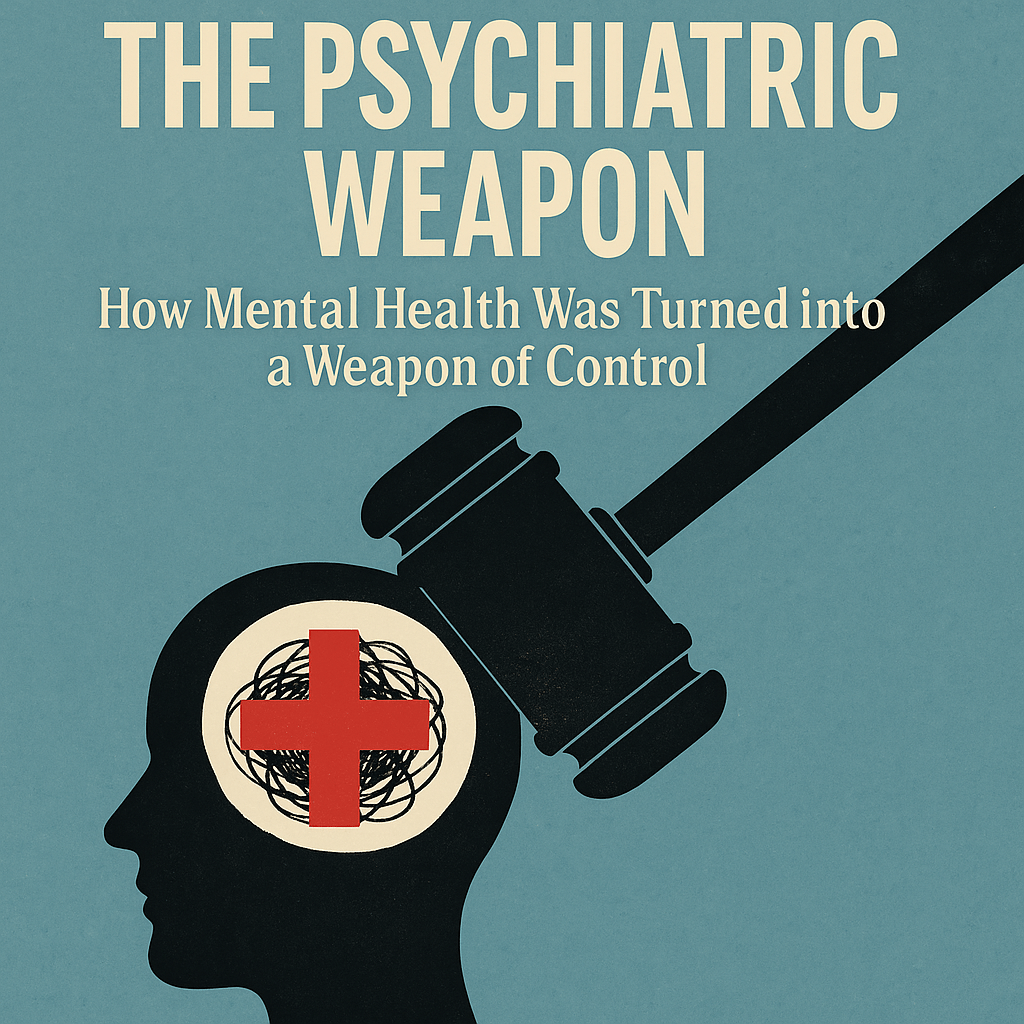
Inside California’s custody-court network where therapists, judges, and evaluators turn diagnosis into control — and trauma into profit.
By Michael Phillips | Father & Co. | CaBayNews
I. The Perfect Weapon
In California’s family courts, it doesn’t take chains or handcuffs to strip a parent of power. All it takes is a diagnosis—and a system ready to exploit it.
Under the banner of “therapy” and “child safety,” psychiatry has become a tool of containment. Judges and evaluators now use psychological labels to control and discredit parents, especially those who live with ADHD, PTSD, or trauma-related conditions. What was meant for healing has turned into a form of modern psychological policing — and, in many cases, crosses into the unauthorized practice of medicine.
Under California Business and Professions Code §2052, it is a crime to “practice, attempt to practice, or hold oneself out as practicing any system or mode of treating the sick or afflicted” without a valid license. Judges are not clinicians, and while they may order a party to undergo a licensed evaluation under limited statutes like Evidence Code §730, they have no legal authority to order therapy or direct medical treatment. When they do, their actions are considered ultra vires — beyond their lawful power.

Brenna Gano, a Bay Area mother and former actor and writer, discovered this truth the hard way. Diagnosed with ADHD and PTSD following a coercive, financially imbalanced marriage, she entered the divorce believing the system would protect her and her son. Instead, her disabilities were used against her.
“They made my disability the reason to take my son away,” Brenna said. “If I show emotion, I’m labeled erratic; if I stay calm, they call me detached. There’s no winning.”
Her case now serves as a detailed case study of systemic practice—a window into how California’s family courts, private evaluators, and AFCC-affiliated therapists weaponize psychiatry for profit.

II. From Healing to Surveillance
The Association of Family and Conciliation Courts (AFCC) trains family-court professionals across the U.S. on “high-conflict” models that reframe parental trauma as pathology. These trainings have created an entire ecosystem of dependency: one that feeds itself through continuous court orders and therapeutic billing.

In this network, evaluators refer to parenting coordinators, who refer to therapists, who refer to court monitors, each reporting back to the judge in a closed feedback loop. This self-reinforcing economy converts family breakdown into recurring revenue.
Brenna’s case followed the same pattern—each court order justified the next round of intervention, with every professional financially linked to the others.
AFCC spokespeople did not respond to requests for comment on referral practices.

III. The Origin Story — The 2018 Family Court Services Report
The first domino fell in November 2018, when Family Court Services (FCS) issued its initial custody report in Brenna’s case. It introduced the foundational falsehoods: that she “yelled,” that she “told her son he and his father were scheming,” and that she was “overly emotional.” No independent verification or witness corroboration appears in the FCS file or subsequent orders.
Weeks later, the Minute Orders and Findings and Orders After Hearing (FOAH) adopted those descriptions as judicial fact. Once that characterization entered the court record, every subsequent evaluator and therapist operated from the same assumption: Brenna was unstable.
These early “personality markers” would later justify the appointment of private evaluators, therapists, and parenting coordinators—all paid from the same household funds. From this point forward, Brenna’s parenting would be monetized.
IV. The Psychiatric Trap — The $40,000 Custody Evaluation
In September 2020, the court appointed Dr. Frank Davis as a Private Child Custody Evaluator, under California Evidence Code §730. His declaration confirmed a $40,000 retainer, split equally between both parties. The order was sold as a neutral “best interests” assessment—but neutrality in family court ends where billing begins.
Soon, the AFCC network tightened around the case. Dr. Matthew Sullivan entered as “therapeutic consultant,” Mindy Dirks as “parenting coach,” and Bill Eddy—AFCC board member and founder of the High Conflict Institute—appeared as a supervising voice in the therapy process.
Each new name represented another billable relationship. Each report they wrote cross-referenced the others, creating a self-validating echo chamber that portrayed Brenna’s trauma responses as “personality disorder indicators.”
V. The Suppressed Report — Dr. Anna Budayr’s Findings
By early 2022, psychologist Dr. Anna Budayr completed a full evaluation. Her findings directly contradicted the narrative that had been building for four years. She diagnosed Brenna with ADHD and PTSD, explicitly noting there was no evidence of any personality or mood disorder. The report humanized Brenna, describing her as intelligent, self-aware, and cooperative despite the emotional abuse she endured.
Then the suppression began. Email exchanges from Brenna’s case file show attorney Stajonne Mialocq Montalvo and Dr. Matthew Sullivan edited the draft to remove favorable language they deemed “too advocacy-based.” What should have been exculpatory evidence became buried in procedural obscurity. The revised version diluted key findings about Brenna’s trauma and omitted context showing her ex-husband’s coercive behavior.
This was not a clinical process—it was political. A system designed to appear therapeutic was, in truth, protecting its financial interests by perpetuating conflict.
VI. The Economic Engine — Profiting from Pathology
Brenna’s Income and Expense Declarations (I&E) from 2024 provide hard numbers behind the rhetoric. Pages 25–26 document tens of thousands of dollars in mandatory therapy and evaluation fees imposed as court orders. Every professional in her case—Sullivan, Dirks, Wexler, and others—was cross-referred within the same AFCC network.
Eva Wexler, appointed as “reunification therapist,” was a particularly egregious example. Her intervention was contraindicated in the custody report, yet still ordered. Coercive reunification therapy is now restricted under Piqui’s Law (AB 1053, 2024), yet courts order similar interventions under labels like ‘therapeutic visitation.’ This follows cases where such treatment was used to punish protective parents. But California courts continue to order it under alternate names like “therapeutic visitation.”
“My lawyer pushed us into reunification therapy even though it was contraindicated,” Brenna recalled. “That’s when they gave Paul the playbook for removing my son from my life.”
This is the AFCC business model in action: mental-health shaming as revenue generation.
VII. The Private-Judging Trap — JAMS and the Loss of Due Process
On February 15, 2022, Brenna attended what she believed to be a simple status conference. Instead, she walked into a private arbitration session with JAMS, one of the nation’s largest alternative dispute-resolution firms.

JAMS (formerly Judicial Arbitration and Mediation Services—a private ADR provider for mediation, arbitration, and judge-for-hire ‘judicial reference’ proceedings.
Stephen Montalvo had recommended JAMS, assuring her it would be “a low-key day just to see where we were at on our positions.” It was anything but low-key. The retired JAMS judge, Catherine Gallagher, presided as both Stephen Montalvo and his wife, Stajonne Mialocq Montalvo, took control of the proceedings. Brenna attended the session from home, alone via Zoom, without any ADA accommodations, despite having documented disabilities and active accommodations in law school.
Under threat of losing custody, she signed an agreement drafted under pressure and undue influence. Both of her lawyers and the private judge made clear that refusal to sign would mean the loss of her son. Within a month, her ex-partner began weaponizing the agreement to escalate abuse through the legal system. When she told her lawyers to rescind it, none supported her. By that point, Paul McNab had spent over $900,000 in legal fees to her $300,000, violating California’s statutory requirement for parity of representation under Family Code §§2030–2032.
“It was clear my own lawyers weren’t working for me,” Brenna said. “They were working for the other side. I was funding my own demise.”
The coercion surrounding the private judging in 2022 was not new—it was the culmination of years of coordinated pressure that began with the “Huge Win with Phil” strategy in late 2018.
VIII. Power, Wealth, and Bias — The Paul McNab Factor
Brenna’s ex-husband, Paul McNab, serves as Chief Strategy and Chief Marketing Officer at Viavi Solutions (NASDAQ: VIAV). SEC filings for Viavi Solutions show McNab’s compensation exceeded $22 million during the marriage—contrasted sharply with Brenna’s unpaid labor as a stay-at-home parent. She had no nanny, no household staff, and no personal income.
Yet, when the custody battle began, the court and its affiliated evaluators treated McNab’s corporate status as proof of rationality and Brenna’s trauma responses as evidence of instability.
This gendered bias, embedded in California’s family court culture, presumes that the high-earning spouse is credible and the caregiver is emotional. The same stereotype fuels the entire mental-health industrial model in divorce litigation.
IX. From Mansion to Infestation — Economic Displacement as Control
The pressure to sell and vacate the Woodside home began in late December 2018, when Brenna’s own attorney, Philip Silvestri, began coordinating with opposing counsel Yvonne Seeley and Amy Sherman to force a sale before any financial discovery had been conducted.
A January 2, 2019, email chain titled “Huge Win with Phil” revealed that Silvestri had “agreed to get Brenna to put the house on the market ASAP,” celebrating the decision as a “huge win” for opposing counsel. The correspondence, forwarded to Brenna by mistake, laid out a coordinated strategy between both legal teams to liquidate the family home and fund ongoing litigation.
“They got me out of the house faster than I could respond,” Brenna recalled. “I believe it was to fund the litigation.”
The email also confirms that the push to sell occurred while her son was still living at home, and before Brenna had received any verified financial disclosures or support. In January 2019, Paul McNab arrived with a moving truck, forcing her to leave with two working dogs and no viable housing plan. What began as a divorce rapidly became a campaign of economic displacement.
In 2019, Brenna was removed from the family’s $6 million Woodside home. She relocated to a 1,000-square-foot rental in Redwood City infested with rats. Her 11-year-old son, already showing signs of anxiety from court-mandated sessions, suffered bites from insects brought in by rodents through the structure’s walls.
When Brenna reported the infestation, her limited-scope custody attorney replied dismissively: “Well, you better do something about that.” The state’s own Family Code, which requires maintaining a comparable standard of living for the child, was ignored.
This form of economic displacement is part of the coercive pattern: remove the parent from stability, then cite their distress as further proof of dysfunction.
X. The ADA Vacuum — How Courts Violate Federal Law
Under Title II of the Americans with Disabilities Act (ADA), California courts are legally required to provide reasonable accommodations for litigants with disabilities. That includes extra time to process documents, simplified scheduling, and communication adjustments for neurodivergent parties.
In Brenna’s case, none of this was offered—not during hearings, not in private judging, and not in therapy compliance orders. The law is clear: when state courts fail to accommodate, they violate federal law. Yet California’s family courts operate as though the ADA doesn’t apply.
Brenna’s April 2022 filing explicitly requested ADA accommodations; the court took no action.
This noncompliance is systemic. Parents with ADHD, PTSD, and trauma histories are routinely denied assistance that could help them participate meaningfully in their cases. Instead, their disabilities become diagnostic ammunition for the court’s own experts. The state’s refusal to enforce ADA standards turns the judiciary into an unregulated behavioral experiment.

XI. The Arizona Mirror — Evidence of a Referral Racket
In 2025, Arizona’s Joint Legislative Ad Hoc Committee on Family Court Orders published findings on systemic corruption within family-law networks. The committee confirmed that attorneys and evaluators formed “a closed referral circuit incentivized to extend litigation.”
Brenna’s case mirrors those findings line by line:
- Referral overlap between evaluators and therapists.
- Suppression of exculpatory evaluations.
- Private judging to remove oversight.
- Financial coercion via therapy orders.
California has not yet conducted such an inquiry. But according to legislative advocates, its structure is identical. The same organizations—AFCC, JAMS, and the High Conflict Institute—dominate training, testimony, and referral patterns across both states.
XII. Data by Design — Numbers Behind the Racket
Judicial Council reports show that as of 2024, more than 40% of California custody cases involved court-ordered psychological evaluation, and nearly half required one or both parties to pay privately for therapy, monitoring, or parent coordination.
Despite $1.2 billion in annual Title IV-D and IV-E funding to California courts (2024 Judicial Council report), intended to assist child-welfare cases, no state agency audits these private payments. The result is an unregulated psychological marketplace wrapped in public authority.
Each evaluation order generates new downstream revenue: therapists, coaches, and parenting coordinators, all of whom depend on ongoing conflict for income. Families like Brenna’s become the raw material for a self-sustaining industry.

XIII. The Psychological Toll and the Manufactured Narrative
By 2024, Brenna’s relationship with her son had been systematically dismantled. Court orders required her to continue therapy even after demonstrating compliance. Each therapist, coach, and evaluator reported her “progress” to the next professional, keeping the cycle alive.
“They break you down until you can’t fight back,” said Renata DeMello, a Title II ADA court-access advocate (not an attorney and not counsel in this matter) who tracks similar California cases. “You lose your home, your health, and your children—and then they say you need more therapy to cope with the trauma they caused.”
Brenna’s story illustrates the cruel paradox of the system: the more you try to heal, the more your efforts are repackaged as instability.
XIV. A Case Study in Modern Coercion
A review of Brenna’s file reads like a legal autopsy of systemic dysfunction:
- 2018 FCS Report: Birth of the false instability narrative.
- 2018–2020: FOAH adoption of unverified behavioral claims.
- 2020 Davis Evaluation: $40K private psychological assessment.
- 2022 Budayr Evaluation: Favorable report suppressed by AFCC-linked professionals.
- 2022 JAMS Private Judging: Coercive, ADA-noncompliant session.
- 2024 I&E Filings: Documented financial depletion.
Each stage transformed emotional harm into billable pathology. Each order deepened dependency.

XV. The Broader Parallel — Dr. Bandy Lee’s Sister
This playbook isn’t confined to California. Dr. Bandy X. Lee, a Yale psychiatrist and former faculty member known for her work on political psychology, has publicly discussed how her own sister lost her children through identical tactics: weaponized mental-health accusations, coordinated court-appointed therapy, and reputational destruction.
Dr. Lee has discussed her sister’s case in multiple podcasts and public appearances, including in 2023 on the Podcast on Crimes Against Women (PCAW); full episode linked.
Even families with psychiatric expertise are powerless once the system labels them “unstable.” The AFCC model—fueled by immunity, secrecy, and profit—reproduces the same harm across jurisdictions.
XVI. Accountability and Reform
To dismantle this system, California must act.
- Enforce ADA Title II compliance in every custody proceeding.
- Prohibit private judging in cases involving disabilities or alleged abuse.
- Mandate public registries of AFCC-affiliated professionals and their financial relationships.
- Require peer-reviewed oversight of custody evaluations and reunification orders.
- Commission a statewide legislative inquiry modeled on Arizona’s 2025 report.
The state cannot allow the privatization of justice under the guise of therapy.
XVII. Epilogue — Beyond Survival
As Brenna prepares for her January 2026 hearing in San Mateo, her case stands as a record of both endurance and exposure. She has preserved every order, every invoice, and every professional correspondence—building the documentary trail that proves what parents across the country have long alleged: that family courts have been repurposed into psychological industries.
“They said I needed help,” Brenna said. “I did—but not the kind they were selling.”
Her fight is no longer just for her family—it’s for every parent trapped in a system that has turned mental health into the ultimate instrument of control.

All facts verified via court filings, declarations, and interviews. See the Appendix for a cast of characters, a list of sources and documentation, and links to further information.
About the Author
Michael Phillips is a journalist and advocate investigating systemic abuse, disability discrimination, and due process failures in America’s family courts. He is the founder of Father & Co., an independent journalism and reform project exposing how the courts profit from family conflict and silence victims of injustice.
 California Bay News
Leave a comment